Why Your E-Commerce Sales Are Stagnating and How to Fix It
In this article5 sections
Key takeaways
- Stalled sales usually come down to five causes: weak conversion, unfocused marketing, forgotten past customers, low trust and decisions made without data.
- Fix the store before buying more traffic. More visitors to a store that doesn't convert only cost more.
- Email flows (welcome, abandoned cart, post-purchase) turn people who already know you into repeat sales.
- Check a few numbers every month: conversion rate, average order value, returning customers and where shoppers drop off.
Sooner or later many store owners hit the same wall: sales stop growing. You keep putting in the same effort and budget, but revenue stays flat, and it's hard to tell what changed. If that sounds familiar, you're not alone.
The good news is that stagnation almost always has a cause you can find and fix. Below are the five most common reasons online store sales stall, what to do about each one, and the marketing work that tends to get growth moving again.
Quick diagnosis: where to look first
Before changing anything, match what you see in your numbers to the most likely cause:
| What you see | Likely cause | First thing to check |
|---|---|---|
| Traffic is steady, orders are falling | Conversion problem | Mobile speed, checkout steps, trust signals on product pages |
| Many visits, few add-to-carts | Product pages don't persuade | Photos, price clarity, delivery information, reviews |
| Ad spend rises, sales don't | Wrong audience or offer | Return on ad spend by campaign and audience |
| Few repeat orders | No retention | Are welcome, abandoned cart and post-purchase emails live? |
| You can't say which channel works | Missing tracking | Analytics and conversion tracking set up correctly |
Five reasons sales stall and how to fix them
1. Your store isn't built to convert
Design and user experience decide whether a visitor becomes a buyer. If pages load slowly, navigation is confusing or the store lacks trust signals such as reviews, clear delivery terms and familiar payment logos, people leave without buying, and you never find out why.
How to fix it: Start by going through your store on a phone, because that's where most shoppers browse. Speed up page loads, simplify navigation and make your value proposition clear at the top of the page. Add trust elements (reviews, delivery and returns information, payment icons) and one clear call to action on each page. Our complete guide to Shopify store development walks through the pages and elements every store needs.
2. Your marketing has no clear target
If your target audience and sales channels aren't clearly defined, much of your marketing budget is wasted. Ads reach people who were never going to buy, or the message doesn't give anyone a reason to act. The budget gets spent and sales barely move.
How to fix it: Define your ideal customer: who buys, why they buy and what they compare you with. Then focus on the two or three channels where you can actually reach them, for example Meta ads on Facebook and Instagram, or Google search ads. Test different messages and offers, and judge them by return on ad spend, not by clicks.
3. Past customers and visitors are forgotten
Many businesses put all their energy into winning new customers and overlook the people who already know the brand. Without abandoned cart reminders, email campaigns or retargeting ads, you're leaving the easiest sales on the table. Selling again to an existing customer usually costs far less than winning a new one.
How to fix it: Build a simple retention plan. Set up a welcome series for new subscribers, abandoned cart and browse reminders, post-purchase follow-ups and regular campaigns to past buyers. Add retargeting ads that remind recent visitors of the products they viewed.

4. Shoppers don't trust or remember your brand
Sales can stall when potential customers aren't confident in your store, or simply don't remember it among all the others they've seen. The usual signs are few customer reviews, a quiet social media presence and a generic message that doesn't say what makes your products different.
How to fix it: Collect and show customer reviews and real photos. Stay active on social media with content that teaches or inspires, not just promotions. Define your unique selling proposition, the one clear reason to buy from you rather than elsewhere, and repeat it on your homepage, product pages and ads. If some of those reviews are negative, our guide on how to handle negative reviews shows how to turn them into a trust signal.
5. Decisions are made without data
Without analysing your traffic and campaign results, you're guessing. You can't see where shoppers drop off in the buying process or which channels actually pay off, so money keeps flowing into tactics that don't work.
How to fix it: Make decisions based on data. Use Google Analytics together with Shopify's built-in analytics, and review the key numbers every month: conversion rate, average order value, returning customer rate, cart abandonment and traffic by channel. Run A/B tests on one change at a time, keep what improves results and drop what doesn't.

Marketing that gets growth moving again
Knowing the cause is only half the job. These are the tactics that most reliably help online stores grow again.
Conversion rate optimisation (CRO)
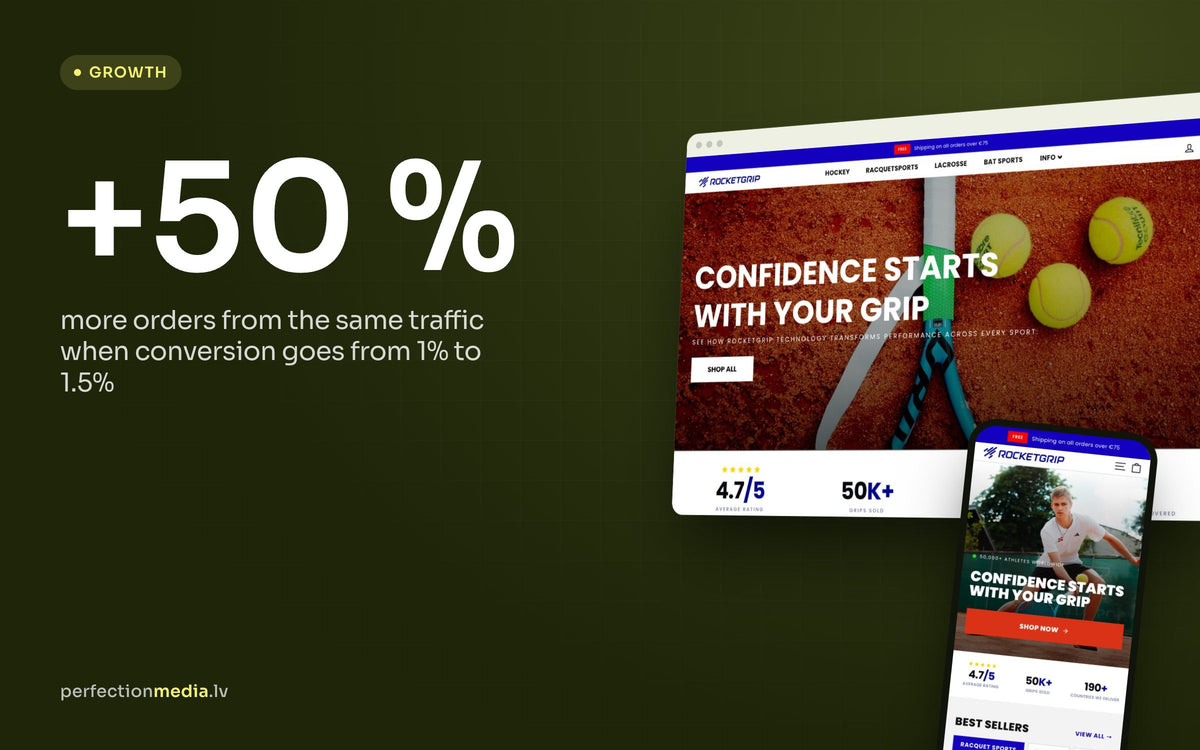
CRO means continuously improving your store so that a bigger share of visitors buys. That covers design, content and the buying process itself: clearer navigation, faster pages, a simpler checkout and more persuasive product pages. Small gains add up. Moving from a 1% to a 1.5% conversion rate means 50% more orders from the same traffic.
Targeted advertising
Used well, Meta (Facebook and Instagram) and Google Ads bring a steady flow of the right visitors. The key is a precise audience and a message that speaks to it. Remarketing campaigns are especially effective: they remind people who left without buying about the products they viewed. If you'd rather hand this over, see how we run Meta ads for online stores.
Email marketing and automation
Email keeps you in touch with customers over the long term and recovers sales that would otherwise be lost. Automated sequences, such as a welcome email for new subscribers, abandoned cart reminders and product recommendations after a purchase, keep working in the background once they're set up. A well-planned email programme raises customer lifetime value and drives repeat purchases. Platforms such as Klaviyo are built for this, and our email marketing service for Shopify stores covers the setup and ongoing campaigns.
SEO and content
Search engine optimisation and useful content bring organic traffic over the long term and build credibility. If your store ranks on the first page of Google for what your customers search, you get a steady stream of visitors without paying for each click. Helpful guides, blog posts and videos also position you as an expert, which makes buying from you an easier decision.

How Perfection Media can help
You can do all of the above yourself. Often the problem isn't knowledge but time. Perfection Media is a Shopify agency in Riga and the first Shopify Select Partner in Latvia. Since 2021 we have built more than 200 Shopify stores, and our clients rate us 5.0 on Google.
- Store builds and redesigns built around conversion. A new store goes live in 4–7 weeks; builds start from €3,000 excl. VAT.
- Monthly growth work from €1,500/month: conversion improvements, Klaviyo email marketing and Meta ads working towards the same goal.
- Shopify Care plans (€149, €249 or €399 per month) that keep your store fast, updated and working.
- Clear reporting: you always know what was done and what it changed.
Conclusion
Stagnation isn't permanent. Find the cause, fix the store before buying more traffic, bring past customers back and let data guide your next step. Most stalled stores have one or two fixable problems, not ten, and solving those is usually enough to get growth moving again.