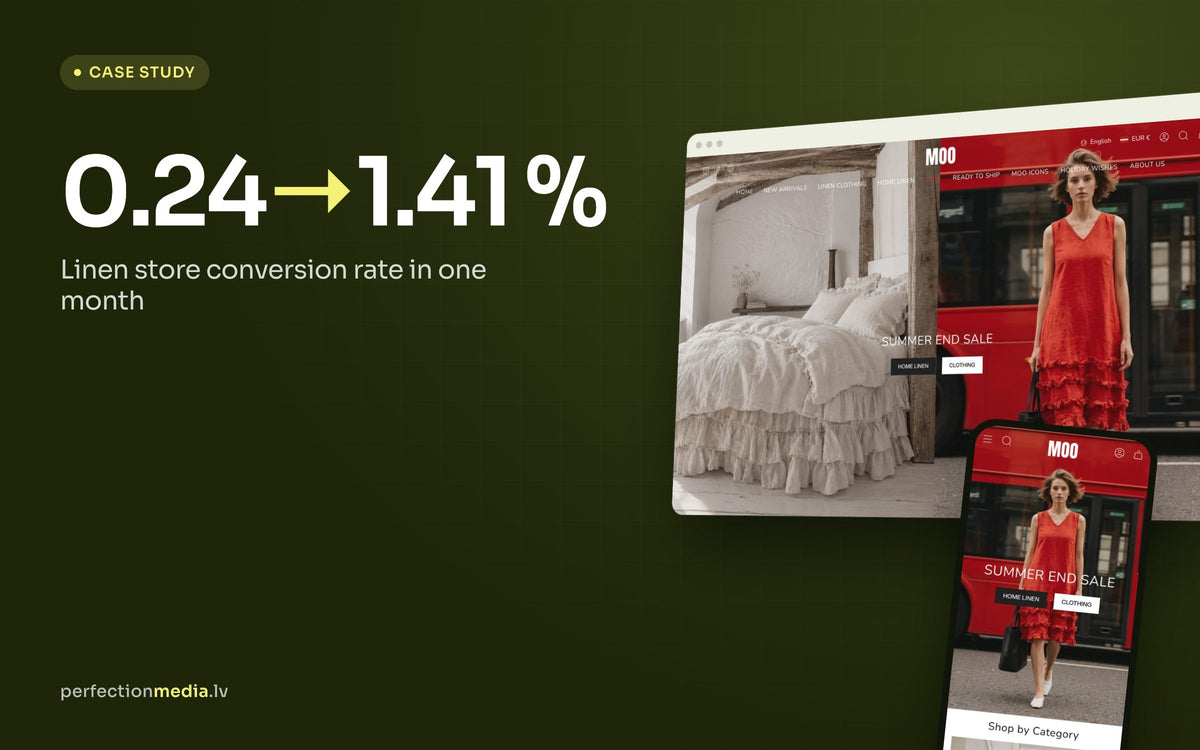
Case Study: How a Linen Store Raised Its Conversion Rate From 0.24% to 1.41% in One Month
In this article8 sections
In October 2024, a small Shopify store selling premium natural linen products made only 2 sales, and its online store conversion rate was 0.24%. The products were good, but the store had few visitors and turned almost none of them into buyers. The owner set a clear sales target for November and asked us to help reach it.
This is what we changed in one month, what happened, and what other store owners can take from it.
Results at a glance
| Metric | Result |
|---|---|
| Online store conversion rate | From 0.24% in October to 1.41% in November |
| Orders | 68 in November, up from 2 in October |
| Store sessions | 4,182 in November, 2,500% more than in October |
| Average order value | Up 72% |
| Return on ad spend (ROAS) | 5.68 on average, up to 8.43 in the best campaigns |
| November sales target | Exceeded |

The starting point
The store had two problems at once. Too few people found it, and those who did rarely bought. Buying more traffic first would have been expensive: at a 0.24% conversion rate, most of the ad budget pays for visitors who leave.
So we worked on both sides in parallel: the store itself, the tracking behind it, and the ads that bring people in.
What we changed in the store
Cart and product pages
We went through the store data to see where visitors dropped off. Then we redesigned the side cart and the product pages so that price, delivery and the next step were clear at a glance.
Offers that lower the barrier
We added price-based discounts (spend more, save more) and a free shipping threshold. Both give the shopper a concrete reason to complete the order and to add one more item.
Navigation and filters
We rebuilt the menu and the product filters, so shoppers could reach the right product in fewer clicks.
Tracking
We set up accurate tracking of customer behaviour. That data showed which pages and offers worked, and it fed the ad campaigns with reliable purchase signals.

Meta ads that found buyers
We launched Meta ad campaigns on Facebook and Instagram with three audience types: broad audiences, retargeting of people who had already visited the store, and audiences suggested by Meta. We tested several creatives and offers to find the strongest combination.
The campaigns reached an average ROAS of 5.68, and the best ones reached 8.43. ROAS is the ad-attributed sales divided by ad spend, so 5.68 means every euro spent on ads brought back 5.68 euros in attributed sales. Retargeting and price-sensitive audiences did most of the work.

The hardest part: finding the right offer
The biggest challenge was finding the offer that turned visitors into customers. After several rounds of testing, price-based discounts combined with a free shipping threshold had the strongest effect on completed checkouts.
We also tested different upsell offers in the cart. They raised cart values, which is a large part of why the average order value grew by 72%.
What to keep in mind
- This is one month. November includes Black Friday, when demand rises for most stores. Part of the jump is seasonal, and that is why we compare conversion rate and ROAS, not just order counts.
- ROAS is attributed by Meta. It is a useful guide for comparing campaigns, not an exact profit figure.
- Every store starts from a different place. Product, margins and existing traffic decide how fast a store can grow.
What your store can take from this
- Fix conversion before you scale ads. A store that converts at 1.41% gets several times more orders from the same traffic than one at 0.24%.
- Make the cart work for you. A clear side cart, a visible free shipping threshold and a relevant upsell lift order value without extra traffic.
- Test offers, not only creatives. The right discount structure mattered as much as the ad visuals.
- Get tracking right first. Without reliable data, you cannot tell which ads and offers earn money.
If your sales have stalled, our article on why e-commerce sales stagnate and how to fix it goes through the most common causes. You can find more projects like this one among our client examples.
Frequently asked questions
Should I start with ads or with the store?
With the store, or at least with both at once. Ads multiply whatever your store already does. If the cart, product pages and offers do not convert, more traffic mostly means a bigger ad bill.
How quickly can conversion work show results?
Changes to the cart, product pages and offers affect every visitor from the day they go live, so with steady traffic you can usually judge them within a few weeks. In this project the change was visible within the first month.
What is a good conversion rate for a Shopify store?
It depends on your niche, prices and traffic sources, so a universal benchmark says little. Compare your store with its own previous months and with the same traffic source, and look for a steady upward trend.
Do I need a full redesign to get results like this?
Not necessarily. In this project, the gains came from targeted changes to the cart, product pages, navigation, offers and tracking, combined with well-tested ads.
If the store itself needs rebuilding, see how we approach Shopify store development.